The short answer: keep a baby sound machine at about 50 decibels (dB) or lower measured at your baby's sleep space, place it across the room rather than in or on the crib, and run the lowest volume that masks household noise. Volume and distance work together — a machine that's perfectly safe across the room can be too loud clipped to the crib rail.
What the research actually says
The American Academy of Pediatrics (AAP) points to roughly 50 dB as a sensible ceiling for infant sleep spaces — about the level of a quiet office or gentle rainfall. A widely cited 2014 study in Pediatrics tested infant sound machines and found that many exceeded safe limits at maximum volume, some loud enough that, at close range over long stretches, they could theoretically affect hearing. The takeaway isn't that sound machines are dangerous — they're a wonderful sleep tool — it's that how you set and place one matters.
Why placement matters as much as the volume dial
Sound falls off quickly with distance (roughly the inverse-square law — double the distance and the sound energy drops to about a quarter). So the single most effective thing you can do is simple: move the machine farther from your baby. A machine on a dresser across the room at a moderate setting can be both effective and well within a safe range, while that same setting clipped to the crib could be too much.
A quick room-by-room guide
- Overnight in the crib: place the machine across the room on a dresser or shelf, at the lowest setting that covers household noise (TV, siblings, traffic).
- Stroller or car seat: if the machine clips on close to your baby, turn the volume down — it's sitting much nearer than it would across a nursery.
- Naps in a bright room: volume rarely needs to go up; effective masking is about consistency, not loudness.
How to check your machine's volume in 30 seconds
Download a free sound-level meter app on your phone. Hold the phone where your baby's head rests and read the dB while the machine plays at your usual setting. If it reads much above 50 dB at that spot, lower the volume or move the machine farther away. It's a rough measurement, not lab-grade — but it will tell you whether you're in the right ballpark.
What to look for in a safer sound machine
- Real volume control — not just two or three preset steps, so you can dial in the lowest level that works.
- A way to place it away from the crib — a stand or flat base beats something that only clips to the rail.
- An amber or warm night light (if it has one at all) rather than blue, so night feeds don't suppress melatonin.
- No jarring loops — an abrupt restart can wake a lightly sleeping baby.
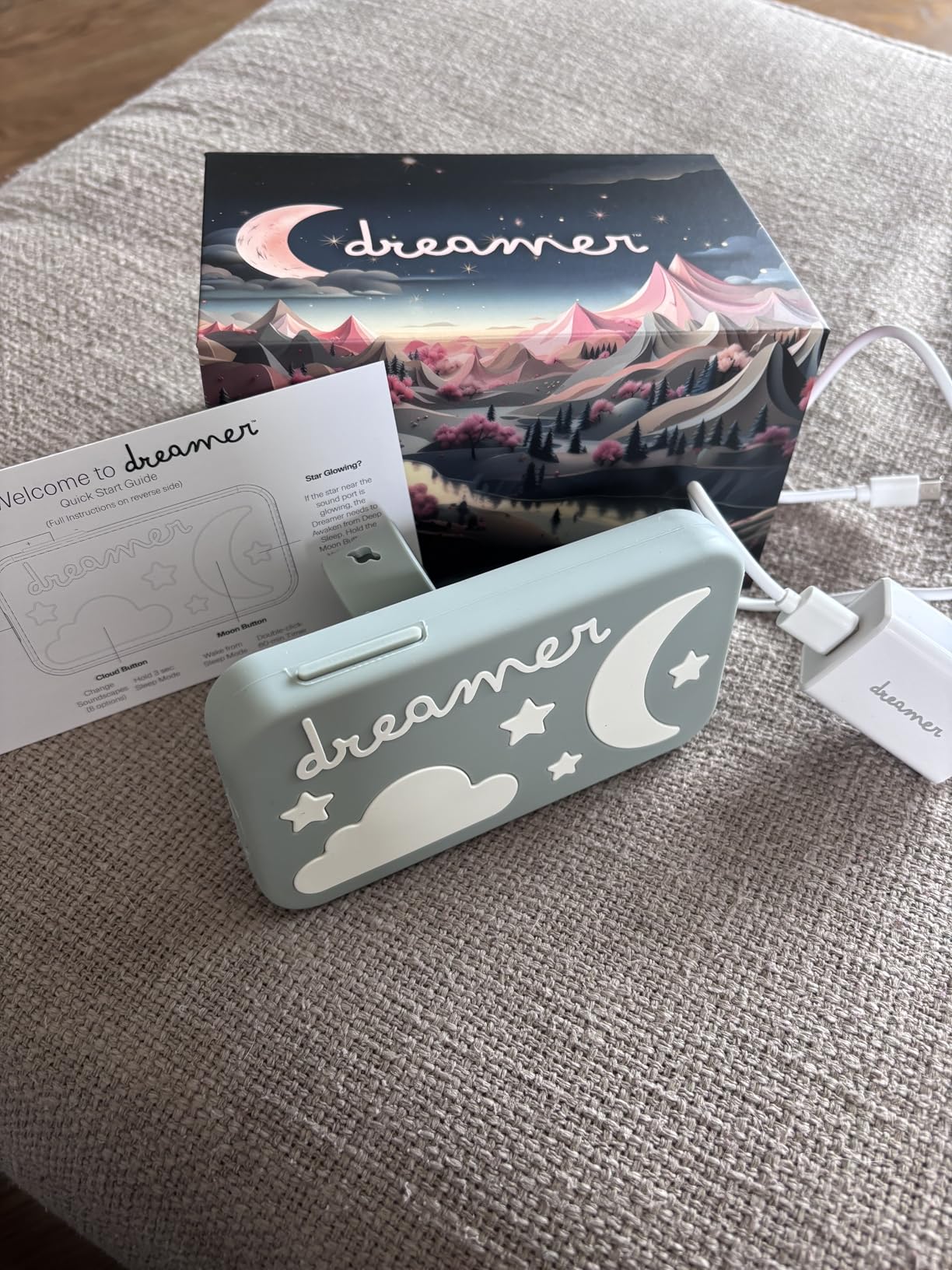
This is the thinking we built Dreamer around: fully adjustable volume, a magnetic silicone strap that folds into a stand so it can sit across the room, and an amber-only night light. Whatever machine you own, though, the safe-volume rules above apply — the dial and the distance do most of the work.
Frequently asked questions
Is it OK to run a sound machine all night?
Generally yes — continuous, consistent sound can help babies stay asleep through normal household noise. Just keep it at a safe volume and distance.
How many decibels is too loud for a baby?
As a rule of thumb, aim for around 50 dB or below at the crib. Well above that, consistently and up close, is worth avoiding.
Where should I put the sound machine?
Across the room from the crib, not in or on it. Distance is your friend.
Can white noise damage a baby's hearing?
At safe volumes and distances, no — it's a helpful sleep aid. The risk comes only from very high volumes at close range over long periods, which the placement and volume guidance here is designed to avoid.
Written by Josh Bronfman, Certified Sleep Science Coach and founder of Dreamer. This article is general information, not medical advice — for concerns specific to your child, please talk with your pediatrician.