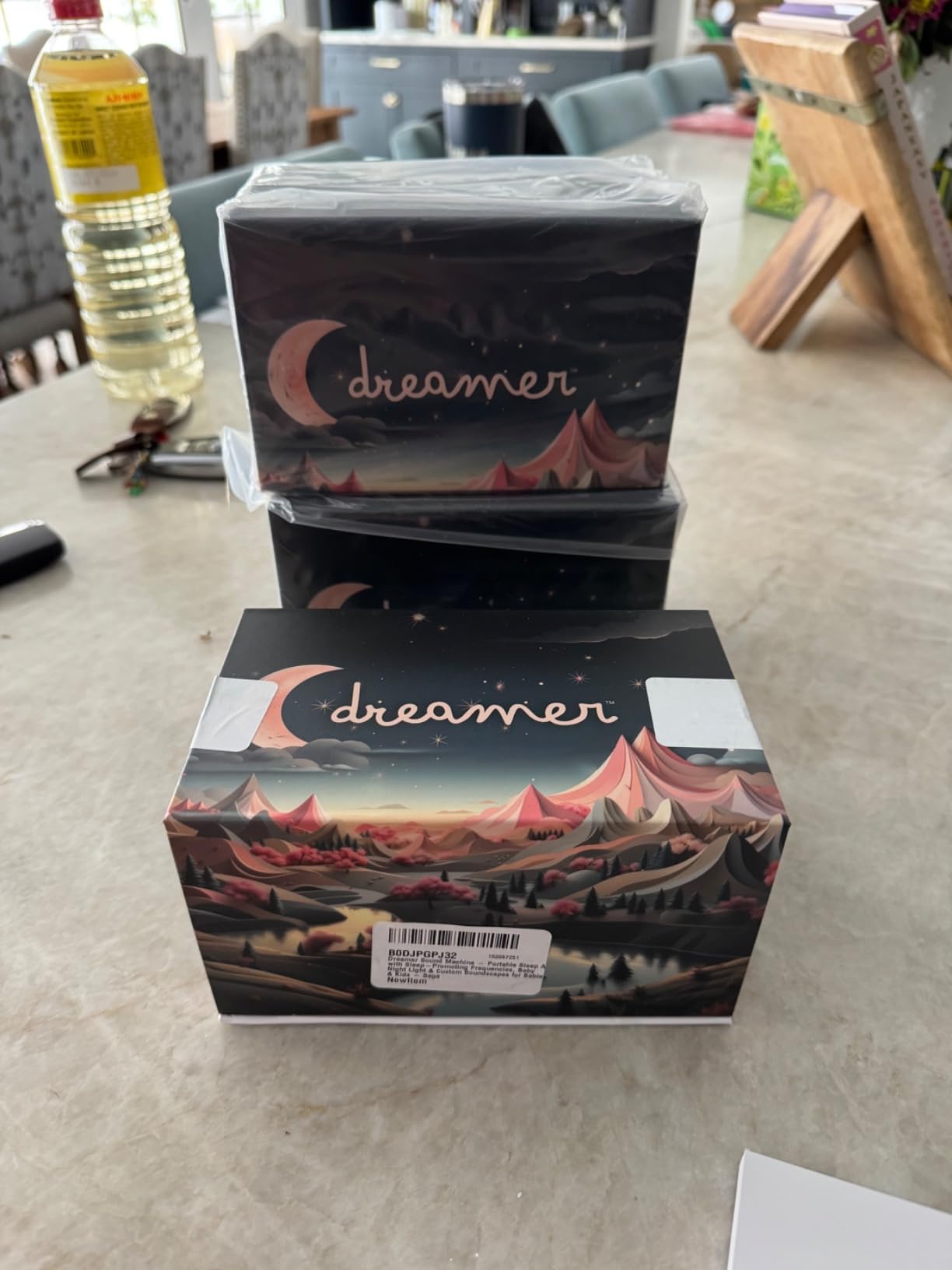
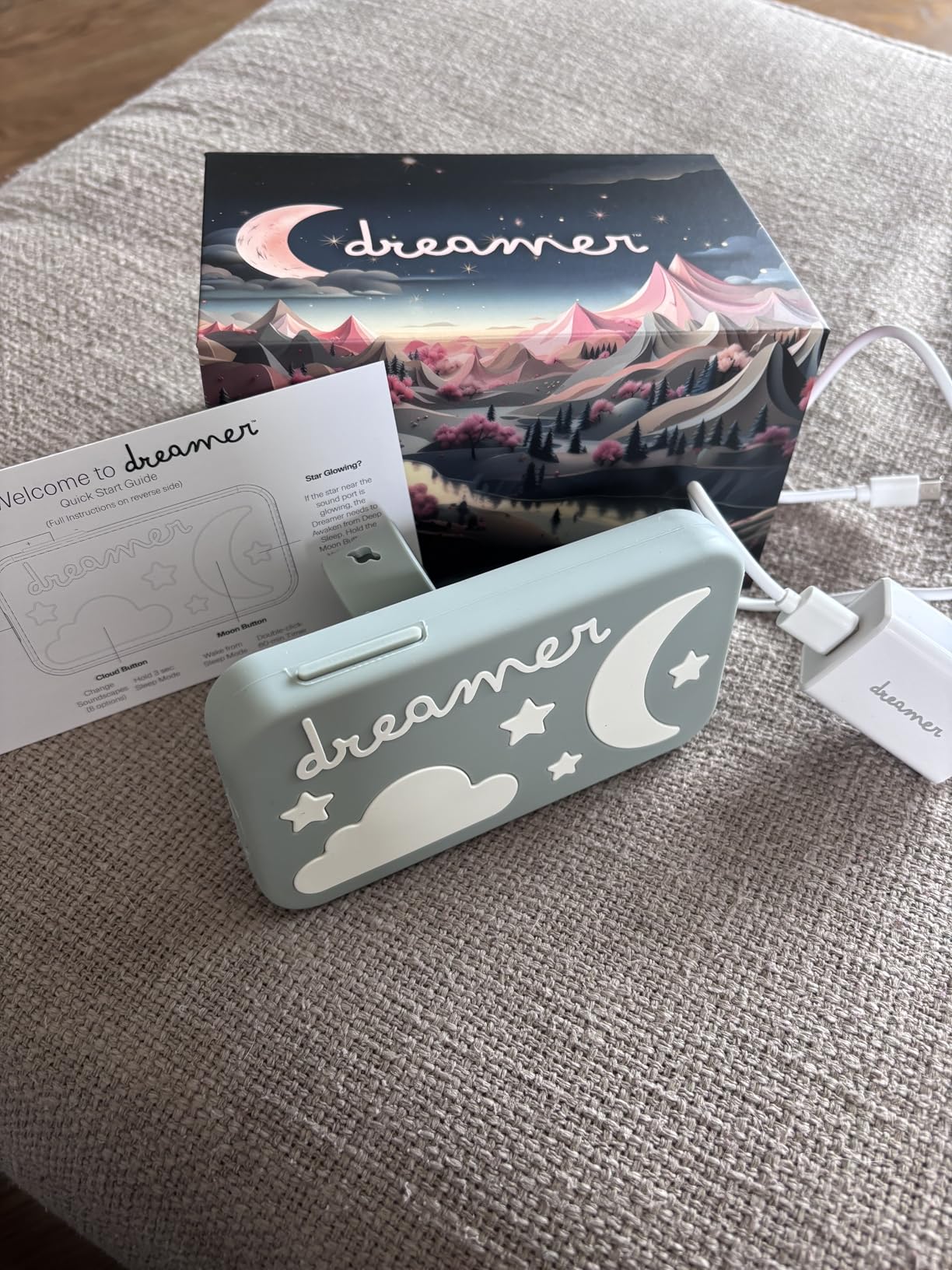
By Josh Bronfman, Founder of Dreamer
Most baby sound machines were designed to solve one problem: how to make a baby's room louder than the dog barking next door.
It's a real problem. Babies wake to ambient noise. Run a fan, or static, or a steady "shhh" loud enough, and you mask the sounds that would otherwise startle them.
This article is the long version of the answer I give every parent who emails to ask, "How is Dreamer actually different?" It includes the parts that don't help me sell anything.
What white noise is, mechanically
White noise is, by technical definition, roughly equal energy across every frequency a human can hear — about 20Hz to 20,000Hz, all at once. Pink noise tilts the spectrum so lower frequencies carry more energy. Brown noise tilts further toward the low end.
What they share is the mechanism: raising the room's noise floor so other sounds become harder to perceive. The auditory system is good at picking out new or sudden sounds against a quiet background. Raise the background, and those signals get washed out.
This is genuinely useful, and it's well supported. It's also most of what any sound machine does — ours included.
What frequency-tuned audio does differently
There is a separate, much smaller, and much newer body of research asking whether specific audio frequencies — rather than broad-spectrum noise — interact with the nervous system in measurable ways.
This is exactly the territory where wellness products oversell, so let me be careful about what the evidence actually supports.
The 432Hz research
In 2019, Calamassi and Pomponi published a double-blind, cross-over pilot study in EXPLORE: The Journal of Science and Healing. Participants listened to the same composition tuned to 440Hz and to 432Hz, without being told which was which.
Listening at 432Hz, participants showed a greater reduction in heart rate and in systolic blood pressure, and reported feeling more relaxed.
What that study is, and isn't. It's a pilot with a small sample. Adults, not babies. It measured short-term physiological markers, not sleep outcomes. It has not, to my knowledge, been replicated at scale. The design was sound and the measurements were objective — but a single small pilot is a reason to keep watching the research, not a reason to make claims.
What about 528Hz?
You'll find 528Hz cited alongside a 2018 study reporting reduced cortisol and increased oxytocin. I cited it in an earlier version of this article, and I've removed it: that paper appeared in a journal whose publisher has a weak reputation for peer review. I'm not comfortable presenting it as evidence.
528Hz is in Dreamer for its tonal character — it produces a warmer, rounder sound than broadband static. That's an acoustics decision, not a claim about hormones.
What this means for babies
A newborn's autonomic nervous system is still developing, and they rely heavily on external cues — being held, rocked, swaddled, and yes, sound — to move from a stimulated state toward sleep.
Whether specific frequencies contribute to that is an open question. What I can tell you is that Dreamer's soundscape is engineered, repeatable, and loop-free, and it sounds materially different from static. That's a real benefit that doesn't require contested science to justify.
The volume problem nobody talks about
One piece of research is too important to leave out, and it doesn't support our frequency approach at all.
In 2014, Hugh and colleagues tested fourteen commercially available infant sound machines and published the results in Pediatrics. They found the machines could produce sound pressure levels above those recommended for infant nurseries when played at maximum volume at typical distances. Several were loud enough that prolonged close exposure raised real hearing concerns.
The practical takeaway applies to every machine on the market, ours included: keep it across the room, at the lowest setting that masks household noise. The AAP recommends around 50 decibels or below at the baby's sleep space. Where you put the machine matters as much as the dial. Our full safe-volume guide is here.
So what does this mean at 2am?
I'll be honest: no sound machine is going to fix your baby's sleep on its own. Nothing will. Sleep is downstream of dozens of inputs — feeding, naps, room temperature, light exposure, developmental stage, genetics, and luck.
What a well-designed sound tool can do is stop being part of the problem. Used at a sensible volume and distance, it covers the noise that causes partial wakings, and it does so with a warmer sound than static. That's the honest claim.
What I'd suggest you do
- Get the volume and placement right first. This matters more than which machine you own. If you do nothing else from this article, do this.
- Decide whether the sound quality matters to you. A cheap fan masks noise perfectly well. If you'd rather have something engineered, loop-free, portable, and amber-lit, that's a smaller category — Dreamer is in it.
- Test it for 90 nights. Sleep is too individual to take anyone's word for it, including mine. If it doesn't make a difference for your baby, send it back — we cover return shipping. Full policy here.
If you want the practical guide rather than the science, The First 90 Nights is free to read and comes with every Dreamer. And our full claims standard sets out exactly what we will and won't say.
— Josh
Josh Bronfman is the founder of Dreamer and a Certified Sleep Science Coach. Dreamer is a NAPPA Gold, Mom's Choice Gold, and Parents Picks 2025 winner, reviewed by five doctors including pediatrician Dr. Jim Sears, MD, and stocked at Nordstrom and buybuy BABY. None of the above is medical advice; if you have specific concerns about your baby's sleep, please consult your pediatrician.
Sources
- Calamassi D, Pomponi GP. "Music Tuned to 440 Hz Versus 432 Hz and the Health Effects: A Double-blind Cross-over Pilot Study." EXPLORE, 2019;15(4):283-290. Pilot study, small sample, adult participants.
- Hugh SC, Wolter NE, Propst EJ, et al. "Infant Sleep Machines and Hazardous Sound Pressure Levels." Pediatrics, 2014;133(4):677-681.